
Most enterprises face a structural challenge when implementing Pay by Bank infrastructure: choosing the wrong provider locks you into months of compliance work, fragmented API coverage, and conversion rates that crater at checkout.
Generic payment platforms won’t address the specific demands of real-time bank data access, variable recurring payments, or PSD2-compliant payment initiation. The honest answer is that fewer than a dozen providers combine trial readiness, documented network scale, and transparent integration workflows worth evaluating.
This review ranks 10 Open Banking infrastructure providers by their demonstrated API depth, geographic coverage, and operational track record — not by marketing spend. These firms differ in measurable ways:
| Firm | Best for | Founded | Notable specialty |
| Finexer | Scaling SaaS platforms | 2019 | Unified AIS/PIS API with 99% UK Bank coverage |
| Plaid | Global fintech infrastructure | 2013 | 12,000+ bank connections |
| Tink | European data enrichment | 2012 | Visa-backed platform |
| TrueLayer | High-volume Pay by Bank | 2016 | 50% UK market share |
| Yapily | PSD2 compliance outsourcing | 2017 | Yapily Connect licensing |
| Bud Financial | Transaction intelligence | 2015 | 98% enrichment accuracy |
| Salt Edge | Multi-region aggregation | 2013 | ISO 27001 certified |
| Volt | Real-time cross-border payments | 2017 | Instant payment schemes |
| Brite Payments | 24/7 instant payments | 2019 | Proprietary IPN network |
| GoCardless | Recurring Direct Debit | 2011 | Automated retry logic |
What Open Banking API Providers Do
Open Banking providers create a bridge between businesses and banks. They let companies pull financial data and initiate payments through clean, standardised APIs — removing the headache of connecting to hundreds of banks individually or managing their own regulatory licences.
They mainly serve fintechs, lenders, SaaS platforms, and payment companies that want to verify identities, review transaction history, or move money directly from bank accounts.
Key capabilities usually include:
- Real-time account information and transaction data (AIS).
- Instant payment initiation (PIS) for Pay by Bank experiences.
- Extra intelligence, such as data enrichment, fraud detection, and recurring payment tools.
Born from PSD2 in Europe and the UK’s Open Banking rules, these platforms solve common frustrations like inconsistent bank formats and compliance burdens. They allow businesses to focus on building great products instead of wrestling with bank integrations.
Best Open Banking Platforms
Discover the leading Open Banking solutions transforming financial services through unified APIs, real-time payments, and intelligent data enrichment.
Finexer
Finexer is a UK-based,Open Banking infrastructure provider built for scaling SaaS platforms, delivering 99% UK bank coverage with real-time financial data through a consolidated API layer.
Founded in 2019, the firm targets businesses that need both bank data access (AIS) and payment initiation (PIS) through a single Open Banking provider, reducing integration and operational complexity.
The platform’s core strength is its unified API combining Bank Transactional Data, Instant Payments, Identity Verification, and Batch Payouts in a single developer experience.
The solution enables businesses to access clients’ bank accounts and initiate payments on their behalf, without the headache of PSD2 compliance and spending much time on coding — a positioning that resonates with lean engineering teams at growth-stage platforms.
Service tiers
| Tier | Target audience | Pricing model | Key inclusions |
| Startup | New businesses | Discounted rates | White label, unlimited accounts |
| Standard | Established firms | Standard pricing | Full feature set, dashboard access |
| Enterprise | High-volume users | Volume-based | Account management, migration support |
Finexer’s white-label capability appears across all tiers, letting platforms embed Open Banking flows under their own branding without visual handoffs.The company positions its pricing tiers to support SaaS platforms scaling Open Banking payment and bank-data workflows without complex feature gating between plans.
Plaid
Plaid is a major financial infrastructure and open banking platform. It lets companies connect to users’ bank accounts, access real-time data, and enable secure payments.
Started in 2013, it now links to 12,000+ financial institutions across 20 markets and powers over 100 million users. This scale makes it the top pick for fintechs chasing wide international coverage.
Key capabilities include account linking, fraud prevention, transaction data, income verification, and payments. It supports both consumer and business use cases, with particular strength in North America.
Tiers:
- Sandbox: Unlimited test API calls
- Free tier: 200 live calls per product for initial testing
- Enterprise: Unlimited volume plus dedicated support
Overall, Plaid’s developer-friendly approach helps teams speed up onboarding, cut fraud, analyse cash flow, and launch instant payments with minimal friction.
Tink
Tink, a European open banking platform owned by Visa, offers payment services, account verification, and smart data enrichment solutions. Launched in 2012 and acquired by Visa in 2022, the company gained powerful support that has accelerated its bank partnerships and cross-border infrastructure growth.
Instead of building multiple regional connections, businesses can access financial data from across Europe through one simple API linked to over 3,000 banks. Tink provides account aggregation, payment initiation, income checks, data enrichment, and risk analysis via clean cloud APIs and developer tools.
What sets it apart is the focus on turning messy data into standardized, actionable insights. This goes well beyond basic connectivity, giving lending, e-commerce, and digital banking teams the decision-making support they actually need.
Pros:
- Visa partnership signals long-term platform stability.
- 4 background data refreshes every 24 hours for continuous account monitoring.
- Sandbox environment accessible via free console account.
Tink provides 4 background refreshes every 24h, which matters for lending use cases requiring near-real-time balance and transaction visibility. The Visa acquisition reduces counterparty risk for enterprises requiring multi-decade vendor relationships.
TrueLayer
TrueLayer is a UK-based Open Banking provider that specialises in instant bank payments and financial data connections. Founded in 2016, it has grown into the clear leader in UK Pay by Bank, processing nearly half of all such transactions.
This scale brings real advantages: higher conversion rates and stronger fraud detection thanks to network effects. The platform supports a full range of services, including Pay by Bank payments, payouts, Bank on File, Signup+, and verification tools.
Businesses can connect directly to customer accounts for fast, secure payments and onboarding without depending on traditional cards.
Key capabilities include:
- Bank on File — store bank details for one-click repeat payments (the Open Banking version of card tokenisation).
- Variable Recurring Payments (VRP) — ideal for subscription and marketplace billing.
- Strong European coverage — processes billions in annual payment volume.
- Full regulatory backing — authorised and regulated by the FCA as a Payment Institution.
- Large active network — over 20 million consumers, adding roughly 1 million new users each month.
By using Open Banking instead of cards, merchants can cut transaction costs by 60-80%. This makes it especially attractive for subscription businesses and marketplaces where smooth repeat payments drive long-term customer value.
Yapily
Yapily is a European open banking infrastructure provider. It enables secure access to financial data and easy Pay by Bank payments through simple unified APIs.
Launched in 2017, the company offers something distinctive: Yapily Connect. This service lets businesses operate under Yapily’s PSD2 licence instead of applying for their own. It connects to over 2,000 banks across 19 countries, with a strong presence in the UK and Germany.
Key features include instant payments, data aggregation, transaction enrichment, bulk payments, and Variable Recurring Payments (VRP). The platform works for both consumer and business accounts, helping streamline onboarding, affordability assessments, verification, and recurring payment setups. These capabilities are particularly valuable for lending, subscriptions, and embedded finance applications.
Target industries:
- Payment service providers
- Digital banking platforms
- Lending and credit firms
- iGaming operators
- Embedded finance SaaS
The Yapily Connect licensing model matters for startups and mid-market firms that need Open Banking capabilities in 6-8 weeks rather than the 6-12 months required for independent FCA authorisation. This approach trades some control for speed and reduced regulatory overhead.
Bud Financial
Bud delivers the intelligence layer that sits on top of Open Banking data. It takes messy, unstructured transaction information from banks and transforms it into clear, categorised insights that financial teams can actually work with.
Since launching in 2015, the company has focused on high-accuracy data enrichment. Its 98% success rate, backed by solid AI and machine learning, makes it especially useful for building personal finance features, smarter lending workflows, and detailed customer segmentation.
Here’s what they offer:
- Advanced transaction enrichment
- Intelligent transaction search
- Customer segmentation tools
- Lending and credit risk analysis
- Precise merchant categorisation
Importantly, Bud doesn’t initiate payments. It specialises in the data layer and is often paired with providers like TrueLayer or Plaid. Banks use it to power everything from subscription insights and affordability assessments to carbon tracking tools — without needing to develop their own complex engines from scratch.
Salt Edge
Salt Edge is a well-established Open Banking provider that offers broad global connectivity. Since 2013, it has built connections to more than 5,000 banks in over 50 countries, making it ideal for businesses with international ambitions outside Europe and North America.
The platform covers essential services such as data aggregation, payment initiation, KYC/onboarding, personal finance management, and real-time data access. Companies can use Salt Edge’s licences instead of securing their own.
Main advantages:
- ISO 27001 certification and PSD2 licensing.
- Support for major standards (Berlin Group, UK Open Banking, Australian CDR, Brazil, and FDX).
- More than 10 years of proven operation.
This combination allows enterprises to launch faster across multiple regions while maintaining strong security and compliance.
Volt
Volt builds infrastructure for real-time account-to-account payments worldwide. Founded in 2017, it solves a common headache by linking major instant payment schemes — like UK Faster Payments and SEPA Instant — through a single API layer.
Businesses can process Pay by Bank transactions, send payouts, handle refunds, and manage virtual accounts without the usual complexity of dealing with different countries and banking systems. It’s particularly well-suited for e-commerce, crypto, iGaming, and retail platforms that need speed and reliability across borders.
Here’s what the platform offers:
- Instant Payments
- Refunds
- Payouts
- Volt Accounts
- Virtual IBANs
- Payment verification
- Strong fraud protection
A notable capability is their Virtual IBAN product. It lets platforms and marketplaces create individual account numbers for sellers or users, making reconciliation automatic and far less manual work — very useful when transaction volumes are high.
Brite Payments
Brite Payments offers the next generation of payment solutions. Founded in 2019, the company focuses on smarter, faster, and more sustainable ways to pay and get paid.
Its proprietary Instant Payments Network (IPN) links directly to over 3,800 European banks and operates 24/7 with almost no fraud or chargebacks. This setup eliminates reliance on traditional card networks and cut-off times.
The platform includes Instant Payments, Instant Payouts, Account Verification, Balances, and Income Insights. Users simply transfer money between bank accounts using local authentication. No apps, no sign-ups, and no manual entry.
Regulatory standing:
| Status | Details |
| Licence | Payment Institution under the Swedish Financial Supervisory Authority |
| Framework | Swedish Payment Services Act (2010:751) and PSD2 |
| Coverage | 3,800+ European banks |
The 24/7/365 operational model matters for businesses serving global customer bases across time zones — traditional bank transfers often fail outside business hours due to bank processing windows. Brite’s continuous operation removes that friction.
GoCardless
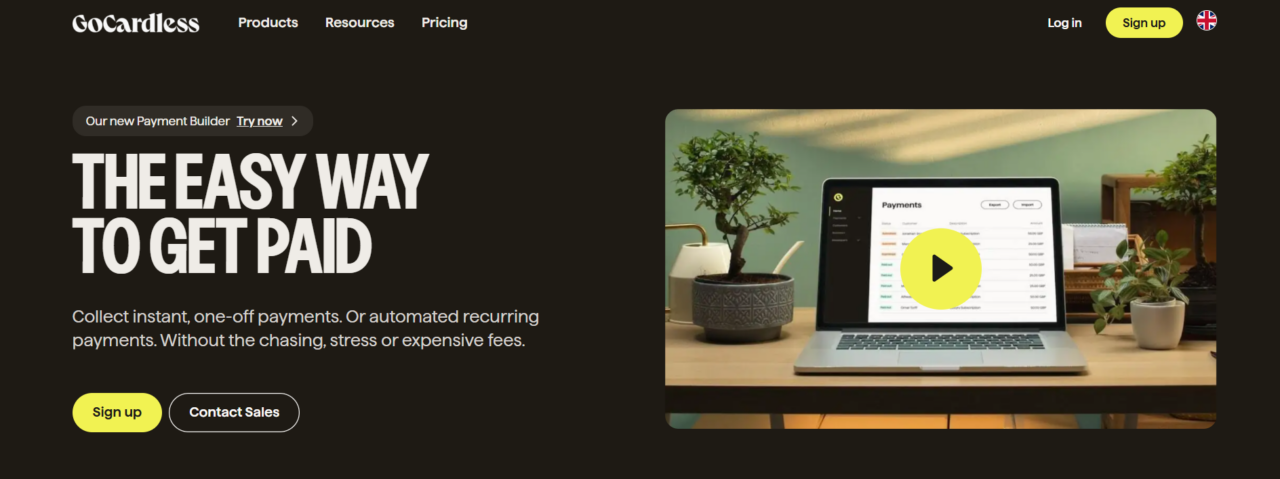
GoCardless is a global bank payment platform that enables businesses to collect one-off and recurring payments directly from customer accounts.
Founded in 2011, it specialises in recurring payments and offers automated retries, tracking, reconciliation, and integrations with more than 350 business tools. This keeps admin overhead low.
The platform operates across over 30 countries, supporting Direct Debit schemes such as UK Bacs, EU SEPA, and US ACH. FCA authorisation provides smaller businesses with the regulatory backing they need.
Key use cases include:
- Subscription services
- Membership organisations
- Instalment payment plans
- Recurring invoice collections
- Utilities and telecom billing
Its intelligent retry logic is especially valuable for subscriptions, as it automatically recovers failed payments and helps minimise involuntary churn.
Conclusion
Match the provider to your use case: UK-focused, pan-European, recurring payments, or instant settlement. No single platform does everything well. Evaluate on three metrics: bank coverage in your target markets, transparent pricing, and deployment speed in weeks, not months. Test sandbox access, API response times, and data refresh rates before committing.
The right provider cuts transaction costs by 60-80% versus cards and removes PSD2 licensing work. The wrong one adds engineering drag and locks you into bad pricing.
Last modified: May 27, 2026